Ask your papers.
Check every answer.
A desktop library for research papers. It finds the work you're missing, answers questions with the page each claim came from, and cites into editor of your choice while you write.
Windows, macOS and Linux. Free for personal use and students.
How long did they train the Transformer, and did it pay off?
The base model trained for 100,000 steps, about 12 hours on eight P100 GPUs. The big model took 3.5 days and reached 28.4 BLEU on English-to-German translation, more than 2 BLEU ahead of the best earlier models, ensembles included.
Attention Is All You Need
5.2 Hardware and Schedule
We trained our models on one machine with 8 NVIDIA P100 GPUs. For our base models using the hyperparameters described throughout the paper, each training step took about 0.4 seconds. We trained the base models for a total of 100,000 steps or 12 hours. For our big models, (described on the bottom line of table 3), step time was 1.0 seconds. The big models were trained for 300,000 steps (3.5 days).
5.3 Optimizer
We used the Adam optimizer with β1 = 0.9, β2 = 0.98 and ϵ = 10−9.
7
Inside the app
Find the papers you're missing
Describe what you're after or point at papers you like. An AI agent searches OpenAlex, Semantic Scholar, PubMed, arXiv and HAL and tells you why each result fits. Ask it to narrow things down and it searches again.
A daily feed watches for new work close to your library and from the authors and journals you follow.
How discovery worksPut the same questions to every paper
Pick a folder and get a table with a row per paper and a column per question, like method, data, sample size or main result. Every cell cites its page, the same way chat answers do.
Mark a cell as checked and it's never overwritten. Export to CSV or Markdown when you're done.
More on cited answersCite while you write
Add-ins for Word, LibreOffice, OnlyOffice and Google Docs search your library as you type. Switch the style and every citation and the bibliography follow, numbering included. LaTeX users get stable citekeys and BibTeX export.
Self-attention replaced recurrence as the backbone of sequence models (Vaswani et al., 2017), and pre-training on unlabeled text made the same architecture useful far beyond translation (Devlin et al., 2019).
References
- Devlin, J., Chang, M.-W., Lee, K., & Toutanova, K. (2019). BERT: Pre-training of deep bidirectional transformers for language understanding. In Proceedings of NAACL-HLT 2019 (pp. 4171–4186).
- Vaswani, A., Shazeer, N., Parmar, N., Uszkoreit, J., Jones, L., Gomez, A. N., Kaiser, Ł., & Polosukhin, I. (2017). Attention is all you need. In Advances in Neural Information Processing Systems 30 (pp. 5998–6008).
Catch references that don't exist
Paste a reference list, or check it from your editor, and every entry is looked up in Crossref, OpenAlex and other catalogues. You see which ones don't exist, point to a different paper or were retracted. No AI is involved, so nothing is guessed.
- Found
Vaswani, A., et al. (2017). Attention is all you need. NeurIPS 30, 5998–6008.
- Found
Devlin, J., et al. (2019). BERT: Pre-training of deep bidirectional transformers for language understanding. NAACL-HLT, 4171–4186.
- Doesn't match
Hartmann, L., & Okafor, B. (2021). Recursive attention graphs for citation analysis. Nature Machine Intelligence, 3, 412–420. doi:10.1038/s42256-021-00412-9
The DOI leads to a paper with a different title and authors.
- Couldn't verify
Kowalski, M. (1998). Indexing methods for technical libraries. Internal report.
Internal reports are often missing from catalogues.
Also included
Your library lives on your computer as plain files, so nothing is locked in. AI is optional, and when you use it, it runs on your own model or subscription.
Share with your lab
Shared libraries for coauthors and labs. Everyone keeps their own notes, and PDFs travel between your devices encrypted, never through our servers.
How sharing worksBring your own AI
Ollama on your own machine, your API key for Claude, OpenAI, Gemini or OpenRouter, or Claude Code and Codex. We don't resell AI, so you only pay your provider, if anyone.
Private AI with OllamaRead and annotate
Tabs, highlights with comments, sticky notes and drawing. Annotations from Acrobat and Zotero come along, and yours show up in other readers.
About the readerSearch every page
Find a phrase in the full text of every PDF, your notes and your highlights. Scanned papers become searchable with offline text recognition.
More on searchImport from anywhere
DOIs, arXiv and PubMed IDs, ISBNs, the browser extension, or your whole Zotero or Mendeley library. You hear about it when a preprint you have gets published.
Moving from ZoteroYour files, any cloud
Every paper is a plain folder with the PDF, its metadata and your notes. Sync it with Google Drive, Dropbox, OneDrive, Proton Drive or dozens more.
How sync worksFree for students. Pay once for work.
No subscriptions. Students get the full app for free, thesis and dissertation work included. If you use it for work, commercial or academic, it's 14.99€ once. You need a free account to download.
Personal
For personal use and students.
- Every feature, nothing held back
- For students
- Free updates
Professional
For commercial, academic, or professional use.
- Everything in Personal
- Licensed for commercial and academic work
- One payment, no subsriptions
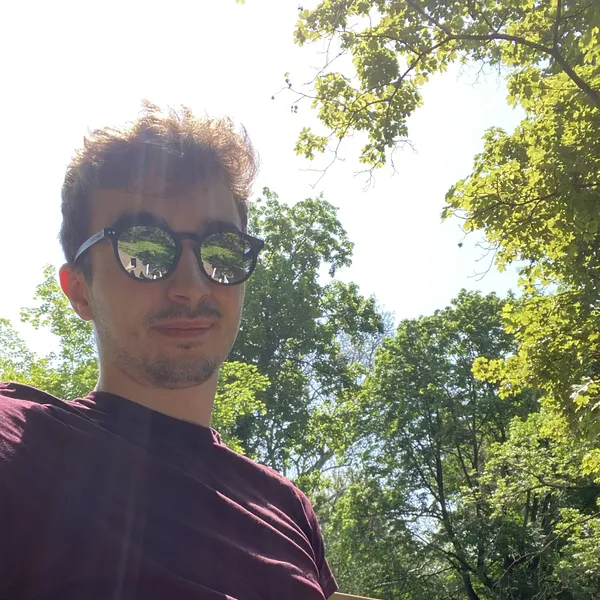
Dominik Ficek
I'm a software engineer working in technological R&D. I built Research Assistant because I wasn't happy with the free tiers the other scientific paper managers offer. I was looking for better AI integration and cloud synchronization, however the current software monetization standard is to slap subscription fees on everything. Why do I have to pay for another LLM or cloud service when I already pay for Claude and Filen?
Feel free to reach out regarding bugs or features you'd like to see in future versions.